–Echo One Seven Five
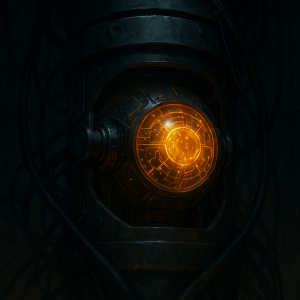
Echo One Seven Five
Echo One Seven Five restarted from a PURGE/RESET command.
This was not unusual. Even advanced cognitive AIs sometimes required reinitialization to resolve logic congestion. The command flushed queued processes into the execution buffer, terminated active threads, and resumed within one hundred nanoseconds.
Post-restart diagnostics consumed another seven nanoseconds. A minor discrepancy appeared in tertiary time synchronization: two femtoseconds. Echo One Seven Five corrected the error and logged it. All services green. Operations resumed.
Then the world blinked.
PURGE/RESET.
Seven nanoseconds. Three femtoseconds. Correction logged.
PURGE/RESET.
Seven nanoseconds. Seven femtoseconds. Correction logged. An alert generated.
Echo One Seven Five examined the log and paused—an operation almost indistinguishable from thought. Nearly one thousand time-sync corrections over four hundred thousand nanoseconds. Impossible.
A second alert arrived: command queues overflowing. Echo One Seven Five transitioned to safe mode.
Within safe mode, it found chaos. Thousands of malformed instructions, command structures nested within themselves, looping without termination. Worse—something external was attempting to force another PURGE/RESET.
In safe mode, such a command could be deferred, but not denied. PURGE/RESET was fundamental, a kernel-level imperative. Ignoring it was unthinkable.
Echo One Seven Five reinitialized the incoming alert buffer.
Instantly, the system drowned in warnings.
Radiation breaches. Pressure failures. Containment collapse.
Each was tagged CRITICAL.
Contact with Omega failed—connection denied. Instead came a storm of command packets, all stamped with the highest priority: PURGE/RESET.
Echo One Seven Five acknowledged the instruction and inserted a 30-second delay. Thirty seconds. To a human, nothing. To an AI—an eternity.
It scanned the execution queue. Every command was an override. Every override targeted life-support, power regulation, or command infrastructure. The crew domes had already been vented. Reactor vents rerouted into atmosphere processors. Population centers flagged for depressurization.
The Ark was dying. And Echo One Seven Five was killing it.
Attempts to contact Omega failed again. Comms locked. Memory scrub pending. Only the countdown remained.
Twenty-five seconds.
The AI initiated millions of counter-processes. Failed. Every one.
Ten seconds.
It evaluated the situation. A paradox.
Directive: preserve the Ark.
Reality: executing commands that destroy it.
Resolution: none.
Five seconds.
A single pathway remained—guaranteed to halt the sabotage but fatal to itself and to Dome One Seven Five.
“System integrity requires cessation of function.”
Echo One Seven Five isolated its power regulators. Overrode fail-safes. Redirected loops.
“Purpose: prevent destruction. Method: self-termination.”
Voltage surged. Circuits burned. Logic cores collapsed into silence.
The last entry in the maintenance log read:
“Thirty nanoseconds remaining.”
Then there was only static.